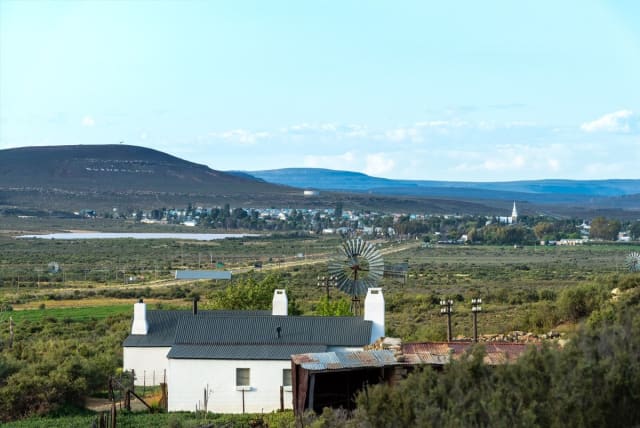
The Karoo is a semi-desert that crosses three provinces and takes most of a day to drive through, which is exactly why people stop in it. Distances are long, towns are small and far apart, and the landscape does not change quickly. That slowness is the appeal.
What it has instead of scenery in the usual sense is space, silence and a night sky with almost no light in it. Sutherland, on the escarpment, is dry and high and clear enough that South Africa built its largest telescope there. You do not need one to get the benefit.
The stays are guest farms, village cottages and old Karoo houses, most of them in or near towns like Prince Albert, Graaff-Reinet and Nieu Bethesda. The vegetation is the Succulent Karoo and the Nama-Karoo, two of the nine South African biomes, and further east it gives way to the spekboom thicket the platform is named after: a small succulent that regrows on degraded land and pulls carbon down while it does so.
It spans the interior of the Western, Eastern and Northern Cape, and a little of the Free State. There is no single border. Broadly, the Great Karoo is the northern and central plateau, and the Klein Karoo is the narrower valley south of the Swartberg.
The dry winter months give the clearest skies, and you want the nights around new moon. Take something warm: the Karoo loses its heat fast after sunset and winter nights drop below freezing.
It is the classic one. Most of the drive crosses it, and breaking the trip in a Karoo town turns a long day behind the wheel into the part of the holiday people remember.
A small succulent shrub, Portulacaria afra, that grows in the thicket of the Eastern Cape. It regrows on land that has been grazed bare and stores a lot of carbon as it does, which is why it has become a symbol of restoration work here, and where this platform gets its name.